
Technology
From MOF material to a scalable heatChiller.
The heatChiller combines water as the refrigerant R718 with adsorption, standardised MOF chips and a purpose-built shell-and-tube heat exchanger.
This makes advanced material technology reproducible, scalable and ready for industrial use.
R718 – Water as a Refrigerant
The refrigerant is water.
The heatChiller uses water as the natural refrigerant R718. It has a GWP of 0, is non-toxic and non-flammable, and requires no PFAS-based refrigerants.
Under vacuum, water evaporates at low temperatures, absorbing heat from the chilled water circuit in the process. It is then condensed and reused in a closed loop.
This makes R718 a safe, permanently available and future-proof solution for cooling.

Adsorption
Cooling driven by heat.
Heat drives a cyclical adsorption and desorption process. Evaporating water under vacuum produces usable cooling. The MOF material takes up the resulting water vapour and is then regenerated with heat.
Because the process is driven by heat, the heatChiller requires significantly less electrical drive energy than a conventional compression chiller and can reduce electrical peak loads.
MOF-Technology
High-performance material.
Reproducibly shaped.

AI enhanced
Standardised technical core component
Uniform ring shape for heat exchanger integration
Basis for scalable, partially automated ring production
We use selected MOF materials and, with our proprietary MOF technology, turn them into a standardised technical component.
The uniform ring geometry enables reproducible manufacturing and the systematic integration of the MOF rings into the heat exchanger. At the same time, it lays the foundation for scalable, partially automated production.
MOF technology as the foundation
With our proprietary MOF rings, we transform the MOF material into a standardised ring shape that can be manufactured reproducibly.
The MOF ring is the uniform core component for heatChillers across different capacity classes.
Designed for the heat exchanger
The MOF rings are integrated into a shell-and-tube heat exchanger developed in-house.
It is based on a proven industrial design principle but has been specifically optimised for the MOF material, the adsorption process and the requirements of the heatChiller.
Custom-designed. Industrially scalable.
The MOF ring remains uniform as the core component, while the shell-and-tube heat exchanger is designed for the specific capacity required.
This allows project-specific heatChillers to be combined with repeatable, partially automatable production of the key components.
Interested in our MOF technology or a potential development partnership?
Talk to us.
In-House Shell-and-Tube Heat Exchanger
Proven principle.
Advanced for our MOF technology.
Our heat exchanger is based on the industry-proven shell-and-tube principle. Its specific design was developed by us for integrating the MOF rings, for the adsorption process and for the requirements of the heatChiller.
This combines innovative MOF technology with a robust heat exchanger design whose geometry can be matched to the required capacity.
The result: complex material technology becomes a heat exchanger component designed for industrial production.
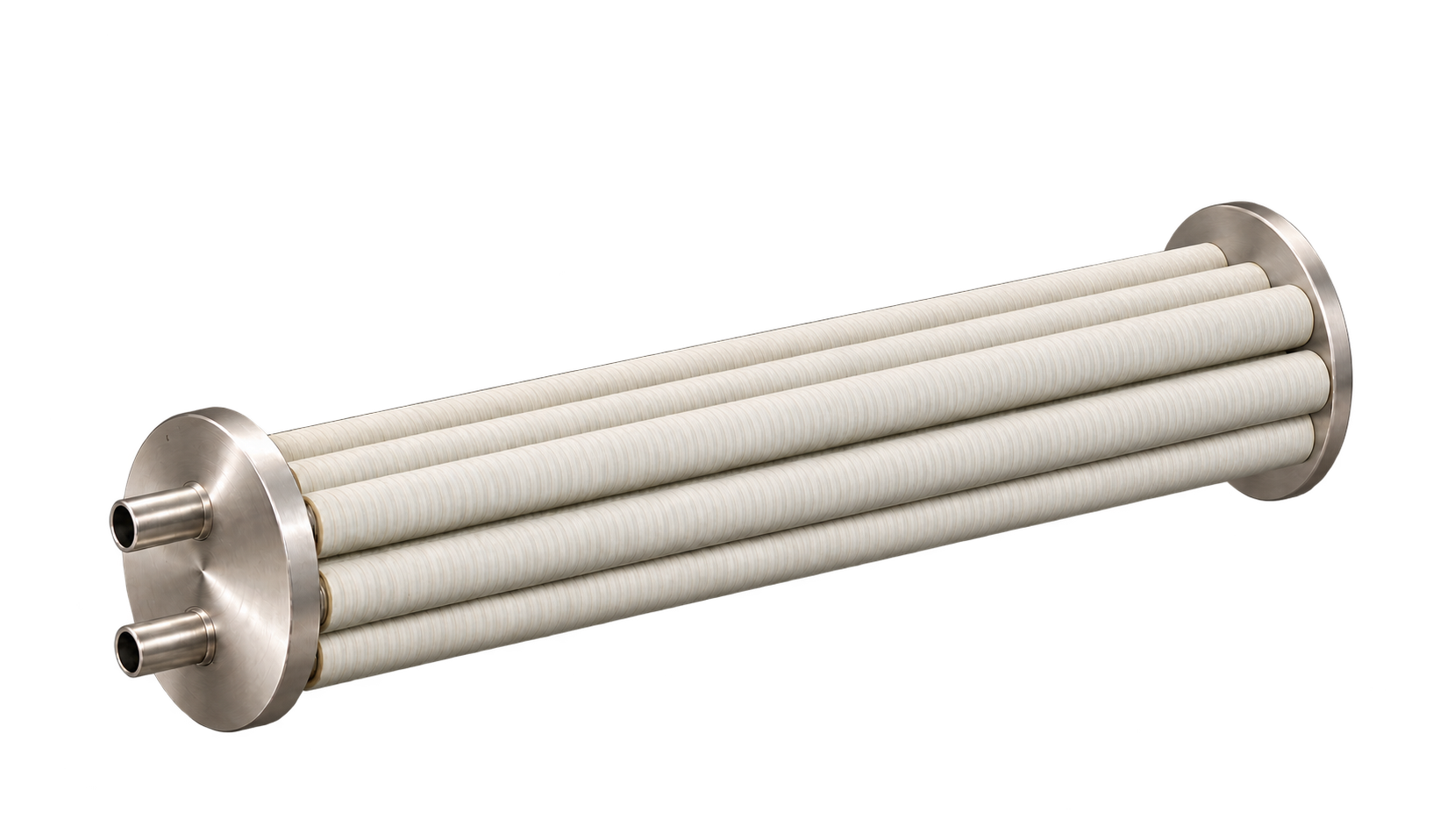
Developed for MOF rings and the adsorption process
Scalable for different capacities and system configurations
Designed for partially automated production on an industrial scale
Heat Rejection System
The right heat rejection
for every site and application.
The heat rejection temperature affects the heatChiller’s performance and efficiency.
That is why heat rejection is factored into the system design from the very beginning.
Selection criteria:
- Location, outdoor climate and installation conditions
- Water availability and water quality
- Hygiene and permit requirements
- Required cooling capacity and heat rejection temperature
- Operating hours and load profile
AI enhanced
Possible heat rejection concepts
Dry heat rejection
Adiabatic heat rejection
Wet heat rejection
Hybrid heat rejection
Project inquiry
Is the heatChiller right for your project?
Briefly describe your cooling requirements or available heat source.
We will get in touch personally to evaluate together which heatChiller configuration is suitable for your project.
1. Describe your project
Provide us with your contact details and a brief description of the application.
2. Check feasibility
Together, we will clarify the cooling demand, heat source, temperatures, and key project parameters.
3. Receive a proposal
You will receive an initial system recommendation, the next project steps, and an estimated delivery window.